
What Virginia Homeowners Insurance Actually Covers for Roof Storm Damage?
In Virginia, standard homeowners insurance covers roof storm damage caused by wind, hail, and falling trees under the dwelling coverage section of your policy. Coverage is provided for sudden and accidental damage, not for damage caused by neglect or an old roof that has reached the end of its useful life. Most policies will reimburse you for the actual cash value (which takes into account depreciation) or the replacement cost value (which is the full cost of repair or replacement). The amount your insurance company pays will depend on the type of insurance policy you have, the age and condition of your roof, and how the claim is documented and filed.
Introduction
If you’re in your Arlington home and you’re looking at a stain on your ceiling that you didn’t see yesterday, you have one question that comes to mind quickly. Will this be covered by insurance?
The honest answer is sometimes, the difference between a covered claim and a denied one is typically a matter of detail that most homeowners don’t read until it’s too late.
This guide explains it simply: what’s included, what’s not, how depreciation reduces your payout, and what you need to do to maximize your chances of winning.
What Types of Roof Damage Are Typically Covered in Virginia
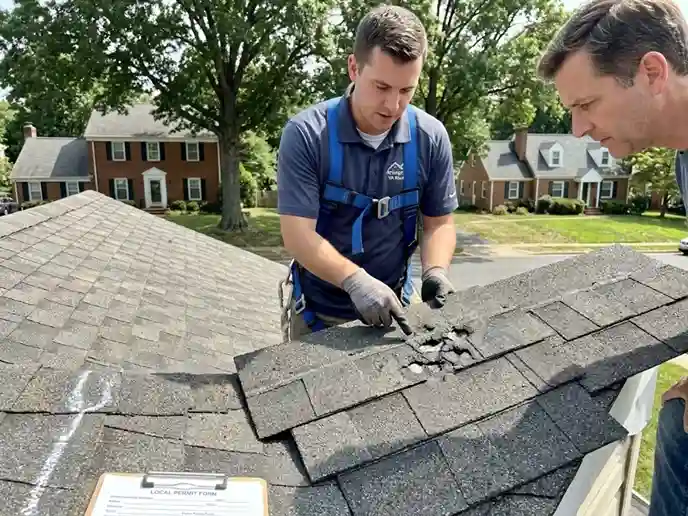
Typical Virginia homeowner policies protect against sudden and accidental damage to the roof. The top three causes of coverage are wind, hail, and falling objects like tree branches.
Wind Damage
Wind coverage is used when there is visible damage due to storm force winds, such as missing shingles, lifted sections, or displaced ridge cap, as documented. Adjusters compare the date you report with the data from the weather service; the storm has to be on record. Events with wind speeds above 40 to 50 mph are most clearly covered.
Hail Damage
Hail coverage is for hail damage, which is identified by the presence of circular areas of shingle damage with granules dislodged from the surface. Even if the hail does not cause an immediate leak, it can be considered if it can be shown to reduce the life of the roof.
Falling Objects
Most standard Virginia policies will cover a tree branch or trunk that falls on your roof during a storm under the falling objects coverage.
An important point to remember: Flooding is not included in a typical homeowners’ insurance policy, no matter what the cause of the flooding is. This will need a separate policy under the National Flood Insurance Program.
What Is Not Covered? Know This Before You File
Age-Related Deterioration
This is the most frequent cause of partial or full claim denials. If your roof is 20 years or older and has a lot of granules missing, shingles that have curled up, or flashing that is worn out, the adjuster might consider the roof to be at the end of its useful life, and not the result of the storm.
Pre-Existing Conditions
If the damage is clearly visible and is not caused by the storm you are claiming, it will not be covered. All of these are commonly reported: previous leak paths left unrepaired, long-term granule loss, and already separated flashing. Having a simple record of previous repairs and inspections will help you identify pre-existing problems from new storm damage.
The impact of depreciation on your payout in Virginia.
The majority of Virginia policies pay on either of two bases. This difference is very important and is not always understood.
Replacement Cost Value (RCV): Reimburses you for the total cost of replacing the roof with a new roof of a similar type, minus your deductible. The actual cost of the repair or replacement is provided.
Actual Cash Value (ACV): Deducts depreciation based on the roof’s age and condition. An asphalt shingle roof that was $12,000 when it was new may be valued at $4,000 when it is 20 years old. Your settlement is for that lesser amount, not the replacement cost.
Check your policy declarations page now, before you ever need to file. Understanding your basis will affect your planning for an event such as this.
How to File a Roof Insurance Claim in Virginia, Step by Step
This is where most homeowners lose money. The process is as important as the damage.
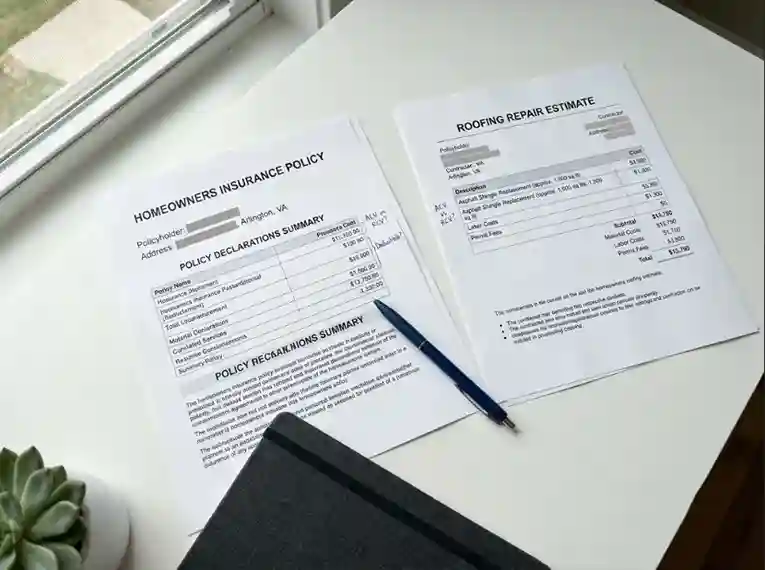
Step1. Document Everything Before You Call
Take pictures of all visible damage from the outside and inside of the house. Write the exact date and time. Obtain local weather service information for your area that verifies the storm event. This documentation is the basis for your entire claim.
Step 2. Claim With Your Insurer
Contact your insurance company directly. Enter the policy number, date of the weather event, and a description of what you can see. Request a claim number and the timeline for the adjuster assignment.
Step 3. Schedule a Contractor Inspection First
Before the adjuster arrives, have a licensed local Arlington roofing contractor inspect your roof. They understand the difference between storm damage and normal wear. Their written evaluation is included in your claim documentation.
Step 4. Request Your Contractor Be Present at the Adjuster Inspection
You can have your contractor on the roof with the adjuster. They can spot damage that the adjuster might miss or mistake for old age. Their involvement is a direct link between the storm and the damage being claimed.
Step 5. Review the Settlement Carefully Before Accepting
The first bid is not necessarily the last bid. If the settlement is not comprehensive of the documented damage, ask for a re-inspection or submit a supplemental claim to your contractor’s written scope and cost estimate. You can also use the appraisal process in your policy in Virginia, which involves an independent appraiser evaluating the damage, and a neutral umpire deciding the dispute with the insurance company.
The Virginia Bureau of Insurance is the official state resource for a complete overview of Virginia property insurance rights.
Understanding Your Deductible
Your deductible is the amount that you must pay before your insurance will pay anything. The standard deductibles in Virginia are between $500 and $2,500. Some policies have a separate deductible for wind and hail coverage, which is usually a percentage of the value of your home.
If a home is insured for $500,000 and has a 2% wind and hail deductible, then the owner would have to pay $10,000 out of pocket before the insurance policy would kick in. That language is in your declarations page. Read it prior to storm season.
Frequently Asked Questions
My roof is over 20 years old. Should I still make a storm damage claim?
Yes. File and receive an adjuster evaluation. This will depend on the type of policy, the condition of the roof, and the extent to which the damage is related to the storm event. Partial coverage is provided for some older roofs. It is best to have a licensed contractor present during the inspection, as this will give you the best chance of a fair result.
Does roof insurance coverage claim increase my premiums in Virginia?
Possibly. Insurers in Virginia might adjust premiums following a claim, especially if there are multiple claims in a brief span of time. If the damage is relatively small and is near your deductible, talk to your agent about the possible increase in premiums before filing.
What happens if the insurance payout is much less than the cost of repairs?
Ask your contractor for a detailed written scope and cost estimate. Line by line compare with adjuster’s assessment. If there are missing items or items are undervalued, your contractor can file a supplemental claim with documentation. If there is a large dispute, consider hiring a licensed Virginia public adjuster or property insurance attorney.
Will a roofing company take care of my insurance claim?
A contractor can help with documentation, offer estimates and be present at the adjuster inspection. To handle or negotiate your claim on your behalf, you need to have a Virginia public adjuster license. When a contractor proposes to take over your claim in full or requests you to sign an Assignment of Benefits, it is a warning sign.
Conclusion
A roof insurance claim in Virginia can take anywhere from a few days to a few months to be resolved.
A settlement offer is usually received within 2-3 weeks after the adjuster’s inspection. The process can take 4-6 weeks with supplemental claims. Significant disputes take longer. Meanwhile, temporary protection measures to prevent further damage should be in place; these costs are usually covered by the claim.
If you have storm damage to your Arlington roof and aren’t sure where your coverage is, you should reach out to your insurance agent. Call our local roofing Arlington, VA team at (703) 386-7359. Before the adjuster even shows up, we examine your roof and provide you with a complete understanding of what you’re dealing with.