
Quick Answer
Drainage issues on flat roofs occur when drains become clogged, slopes break or membranes deteriorate at drain collars. Structural damage occurs after water has been standing for more than 48 hours. Most problems can be solved by drain cleaning, slope correction or membrane repairs. Early detection is a small price to pay for delayed repairs.
Introduction
Flat roofs are everywhere in Arlington. Commercial along Wilson Boulevard, mixed use near Ballston, older apartment complexes off Columbia Pike. They look simple. However, most of them fail quietly in the drainage.
Water on a flat roof doesn’t simply go away. It sits. It finds gaps. It creeps through seams, flashing and layers of membrane until it emerges as a stain on your ceiling or a buckled area of decking you never expected.
The majority of flat roof drainage issues can be solved. The secret is to know what you’re searching for before it gets too far out of hand.
Why Flat Roof Drainage Is Different
Water is designed to flow off pitched roofs. Most of the work is done by gravity. The success of a flat roof is entirely reliant on the drainage system, which must be installed properly and maintained regularly. Any failure, no matter how small, results in ponding water for roofers. Water that remains on the roof surface for over 48 hours after the rain has ceased.
Ponding isn’t a style thing. It increases the load on the roof, which was not intended to support it over the long term. It breaks down membranes and penetrates all weak spots. Arlington receives approximately 42 inches of rainfall per year, along with ice storms and freeze-thaw events in the winter months in Northern Virginia. A drainage system that works well in the summer can collapse in January if it gets blocked by ice.
Common Flat Roof Drainage Issues
Clogged or Blocked Roof Drains
This is the most prevalent flat roof drainage issue and the easiest to avoid. All leaves, dirt, debris and in older buildings, old roofing material are collected in flat roof drains. If a drain becomes clogged, water cannot flow. Drain blockages after a storm are very common in Arlington neighborhoods with a high percentage of trees, such as Cherrydale or Dominion Hills. A high wind one afternoon in October can fill a drain that was clear the previous week.
Improper Slope or Low Spots
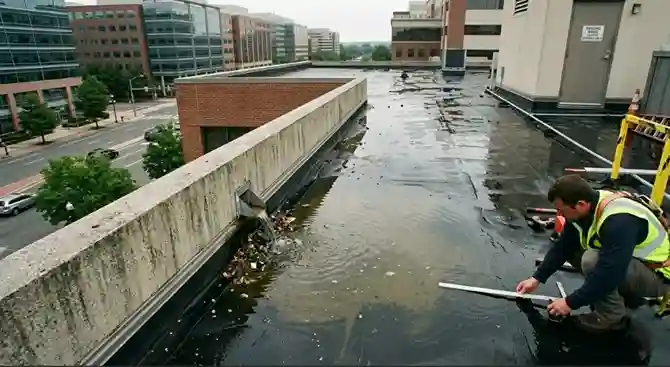
All flat roofs should be sloped, even a quarter inch per foot will help to direct water to the drains. With time, structural settling, heavy equipment installations or original installation mistakes result in low spots that trap water every time it rains. This is not a hose fixable drain issue. It needs to be re-sloped or drainage points added in the affected areas.
Scuppers that are too small
Scuppers are openings in the parapet wall that let water drain off the edge of the roof. If scuppers are too small or too far apart, they will not be able to remove water quickly enough during heavy rain. The water backs up and pools as the scupper continues to drain the previous water. This is a design issue that is frequently found in older Arlington commercial buildings constructed prior to current code requirements.
Membrane Failures Around Drains
The immediate area surrounding a roof drain is one of the most critical areas of the entire roof. If the membrane rises, cracks or tears from the drain collar, water will work under the membrane before it reaches the drain.
This is a flat roof drainage issue that is frequently attributed to the drain itself, but actually stems from the failure of the membrane around the drain.
Sagging or Deteriorated Roof Decking
Even if the drainage system is good, water accumulates in the softened or deflected roof deck. If the deck has soft spots underfoot, if the ground is depressed from the surface, or if there are stains on the interior of the ceiling after rain, the deck may be compromised.
If water is retained on the decking, it will deteriorate more quickly. The repair scope can be multiplied by a factor of two after a season.
How to Fix Flat Roof Drainage Problems
Regular Drain Cleaning
The best solution is the cheapest. Two times a year, in the spring and fall, cleaning roof drains twice a year will prevent most of the blockages from causing damage. Quarterly cleaning is a better idea for properties that are surrounded by trees. The price of a drain cleaning is a small fraction of the price of membrane repair or deck replacement.
Installing Additional or Overflow Drains
If the existing drainage system is not capable of accommodating the roof’s water volume, then it is time to add drains. Overflow drains are located above the main drain and only operate when the main drain is overfilled. They help to keep the pond from flooding during heavy rain, and in Northern Virginia, heavy rain is more common than most people realize.
Tapered Insulation to Correct Slope
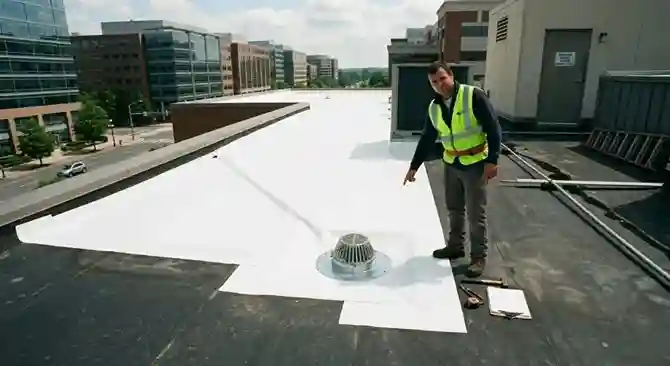
Tapered insulation systems restore proper slope when flat roof drainage issues are caused by low spots, but without the need to rebuild the roof. Insulation board is installed by contractors in different thicknesses to guide the water to existing drains. A frequent solution for commercial re-roofing projects in Arlington where the structure cannot be altered.
Drain Collar and Membrane Flashing Repairs
If the membrane around a drain has failed, the solution is to cut back the damaged membrane and replace it with new flashing and ensure it is properly connected to the rest of the membrane system. A contractor that just seals around a drain collar without fixing the membrane failure is providing a short-term solution that will be short-lived for another season or two.
Warning Signs to Look for After Heavy Rain
It is not always necessary to have a roofer on the roof to identify early warning signs. Recurring ponding in a particular area is indicated by water stains on the roof membrane in ring shapes. If water stains are found or developing on the interior of the ceiling, water is entering. If the roof decking is damaged by prolonged moisture, it will show soft or spongy spots underfoot when walking on the roof. If debris can be seen around the drain strainer, the drain is overworked. Rust on a parapet running down from a scupper indicates that water is not draining properly and is always overflowing.
Any one of these warrants a professional inspection. Flat roof drainage problems almost never resolve on their own.
Why Waiting Makes Flat Roof Drainage Problems Worse
A clogged drain costs almost nothing to fix. The cost of the water damage that can result from neglecting it can easily exceed $10,000 when deck replacement, membrane replacement and interior repairs are added in.
The majority of flat roof drainage problems are slow. They don’t make themselves known. They slowly cause damage with each rain, until the price becomes too high to overlook. The one thing that building owners can do for a flat roof that is the most cost-effective is to have regular maintenance inspections after storm season and before winter.
Conclusion
The flat roof is suitable if the drainage system is designed properly and maintained regularly. If either of them fails, water will get in. The fixes are almost always less expensive than the damage. But timing matters. A flat roof drainage issue in the fall is much less expensive than a flat roof drainage issue in the winter in Northern Virginia.
Arlington VA Roofing provides flat roof inspection, drain maintenance and drainage repairs in Arlington and Northern Virginia. Call (703) 386-7359 to schedule a flat roof inspection.